Sommario
From March 9 to 13, Cannes hosted the 36th edition of MIPIM, one of the leading international events dedicated to real estate, bringing together more than 20,000 professionals from around 90 countries. Investors, developers, asset managers, and institutional representatives gathered on the Croisette to discuss market dynamics, including investment strategies, urban regeneration, and new technological tools for asset management and value creation.
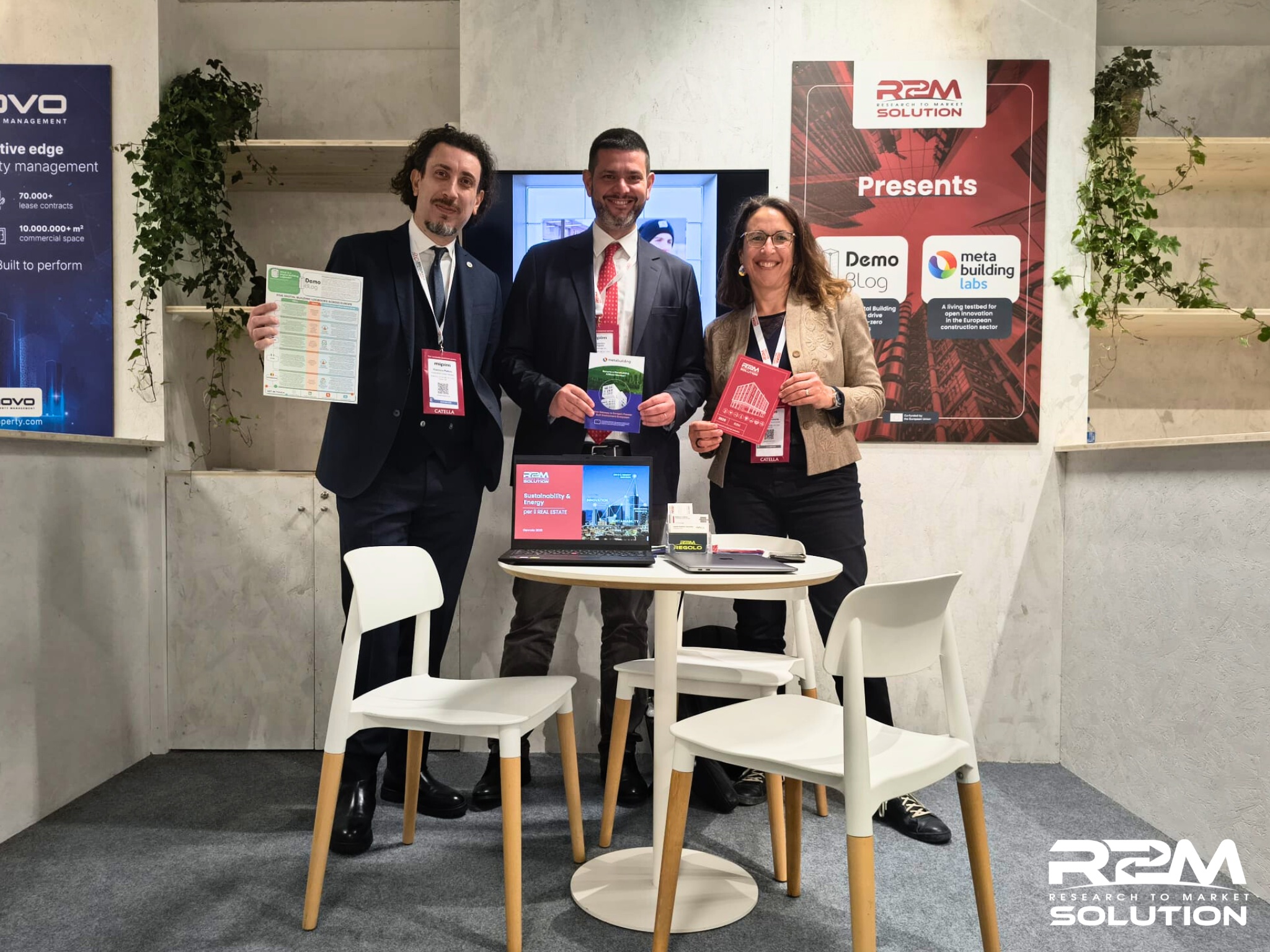
R2M Solution attended the event with Alessandro Lodigiani, Country Manager Italy, and Gianluca Padula, Sustainability Division Manager, together with colleagues from the French branch Sophie Dourlens-Quaranta, Managing Director, and Christopher Klink, R&I Project Manager.
The return of investor interest in European real estate
During the days in Cannes, the team took part in several discussions with investors and international operators, confirming MIPIM’s role as a key observatory of developments in the real estate capital market.
After a period marked by macroeconomic uncertainty and rising interest rates, many investors are once again looking more closely at the opportunities offered by the European real estate sector. This was one of the clearest signals emerging from panels and bilateral meetings throughout the event.
In these evaluations, market fundamentals continue to play a central role. At the moment, Italy is attracting increasing attention thanks to the strength of some segments and the development potential of several urban contexts. This interest is not limited to well-established major markets but is also expanding to emerging and evolving locations.
Rome returns to the center of investment strategies
Among the cities attracting growing attention is Rome. While Milan has absorbed the largest share of capital in the Italian real estate market in recent years, many operators are now looking again at the capital with renewed interest. Urban transformation projects currently underway—from the redevelopment of the Mercati Generali area to the development of the Guido Reni district—are helping to reignite investor attention and bring the city back to the center of development strategies.
According to several observers, Rome may be at the beginning of a new phase in its real estate cycle, with projects expected to transform key urban areas and generate new opportunities for investors and developers.
MIPIM also confirmed the vitality of several specific segments. Among the most closely watched are residential, hospitality, and data centers, the latter becoming increasingly central to investment strategies linked to the digital transformation of the economy. These sectors are very different from one another but share strong structural demand and growth prospects that continue to attract capital from around the world.
New European policies and the digitalization of buildings
On the sidelines of MIPIM, Alessandro Lodigiani was interviewed by Quotidiano Immobiliare
about the implications of the new EPBD directive. Among the new measures introduced is the digital building logbook, a tool designed to collect and update technical and performance data on buildings over time. According to Lodigiani, this represents a shift that goes beyond the technical dimension:
“The digital logbook marks an important step because it introduces a new data culture in the real estate sector. Having reliable and up-to-date information about buildings will increasingly become a key factor for asset management and investment decisions.”
This topic had already emerged during the recent RICS Italia Conference, where the logbook was presented as a useful tool for the entire value chain—from valuation and due diligence activities to operational management and refurbishment—and as a cultural shift even before a technical one, encouraging the sector to rethink how building data is collected and used.
Our solutions for building decarbonization
Starting precisely from this data-driven approach, R2M Solution presented at MIPIM several of the solutions developed in recent years. Within European programs such as Demo-BLog and MetaBuilding Labs, focused on building digitalization and innovation in the construction sector, new tools have been developed to simulate decarbonization pathways at both building and portfolio level, supporting asset managers and investors in evaluating different intervention scenarios in a rapidly evolving regulatory framework.
On the operational management side, BrainBox AI brings artificial intelligence to the optimization of HVAC systems. Already active on more than 40 million square meters worldwide, it is a plug-and-play solution that improves the energy performance of buildings without requiring structural interventions, with short implementation times and measurable results from the first weeks.
Completing the picture are digital twins of buildings: scanning and modeling technologies, such as those enabled by Matterport, that allow the creation of accurate digital representations of properties and the collection of valuable data for both daily management and future planning. A frontier that is rapidly moving from experimentation to real-world adoption, including across large real estate portfolios.
However, sustainability goes beyond the individual building. Increasing attention is being paid to tools capable of supporting climate adaptation strategies and improving environmental quality at the urban scale. In this context, solutions based on Nature-Based Solutions—such as the Greenpass and NBenefit$ by LIST platforms—enable the measurement and simulation of the impact of green infrastructure on the urban climate, supporting design decisions aligned with sustainability goals and ESG criteria.
Data, technology, and energy transition: these are the key drivers shaping the competitive strategies of the European real estate sector. And these are the levers on which R2M Solution works every day, with concrete tools and a consolidated international presence.